Back to Problems
F = ma (Final Problems)
Momentum
FMA-2007-38 · 2007 F = ma (AAPT)

2007 F = ma Exam — Question 38

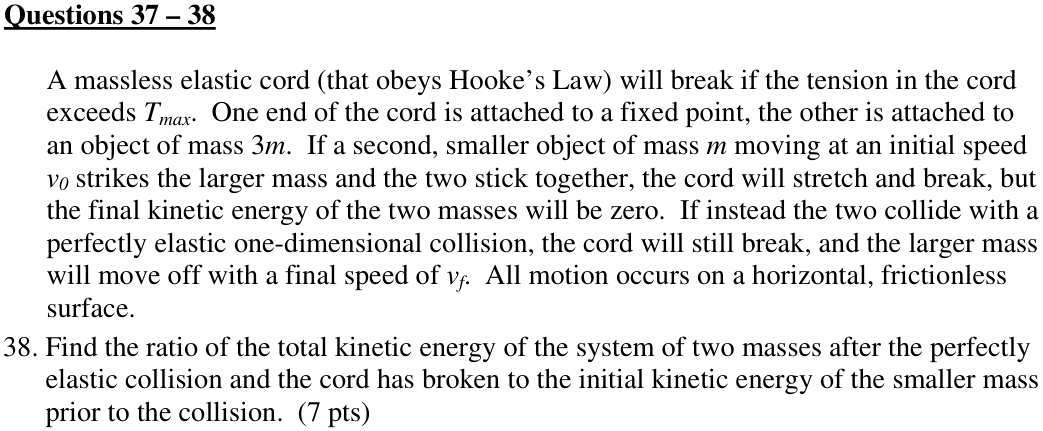
Questions 37 – 38 A massless elastic cord (that obeys Hooke’s Law) will break if the tension in the cord exceeds Tmax. One end of the cord is attached to a fixed point, the other is attached to an object of mass 3m. If a second, smaller object of mass m moving at an initial speed v0 strikes the larger mass and the two stick together, the cord will stretch and break, but the final kinetic energy of the two masses will be zero. If instead the two collide with a perfectly elastic one-dimensional collision, the cord will still break, and the larger mass will move off with a final speed of vf. All motion occurs on a horizontal, frictionless surface. 38. Find the ratio of the total kinetic energy of the system of two masses after the perfectly elastic collision and the cord has broken to the initial kinetic energy of the smaller mass prior to the collision. (7 pts)
Source: Question 38, 2007 F = ma Exam, © 2007 American Association of Physics Teachers (AAPT) and the U.S. Physics Team. Adapted by PhysicsTrainer: reformatted into a separate question and answer choices for online multiple-choice practice; any shared setup from nearby questions is repeated here. Not affiliated with or endorsed by AAPT or the U.S. Physics Team.